
SIGN IN YOUR ACCOUNT TO HAVE ACCESS TO DIFFERENT FEATURES

Login with Google

CREATE AN ACCOUNT FORGOT YOUR PASSWORD?

FORGOT YOUR DETAILS?

AAH, WAIT, I REMEMBER NOW!

CREATE ACCOUNT

ALREADY HAVE AN ACCOUNT?

Login with Google

QUESTIONS? CALL: 865-637-8986
  • SIGN UP
  • LOGIN

SimpleIndex

  • Solutions
  • Features
  • Pricing
  • Download
  • Docs & Support
  • My Account
  • MY CART
    No products in cart.
Tuesday, 16 June 2026 / Published in Newsletter

SimpleIndex Tips & Tricks – OCR Document Separation

OCR Document Separation

Streamline Your Workflow with OCR Document Separation

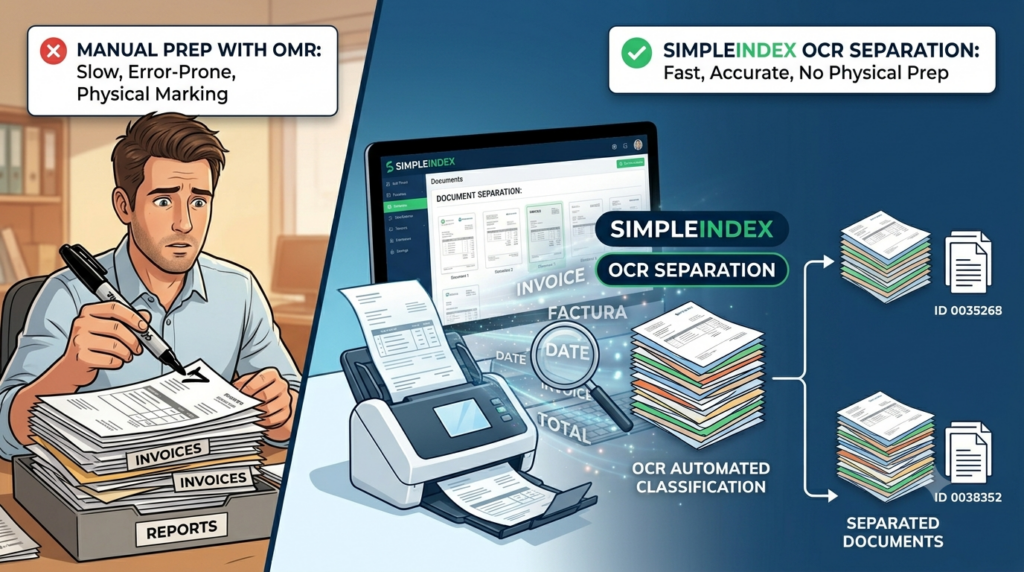
In a previous newsletter, we shared one of our favorite low-tech, high-efficiency hacks: OMR Document Separation. For teams dealing with highly variable, unstandardized paperwork, making a simple black mark with a felt pen on the first page of a new document is an incredibly fast way to tell SimpleIndex exactly where to split a file.

But what if you want to skip document prep entirely? What if you don’t want to mark up your physical papers or manually insert barcode separator sheets?

Enter OCR Document Separation – the hands-free, fully automated way to organize your multi-page workflows.

The Problem: When Document Attachments Break Your Indexing

Standard indexing in SimpleIndex automatically separates documents when a unique value (like a new barcode or account number) is read. But real world scanning isn’t always that clean.

Consider an AP department processing invoices that come with packets of unpredictable attachments (receipts, shipping logs, correspondence). If your system searches for “Invoice Date” or “Total” on every single page, those attachments will trigger false positives, slow down processing times, and mess up your data export.

The Solution: Smarter Separation via OCR

Instead of prepping files manually, OCR Document Separation uses Text Recognition to scan the document layout and identify specific keywords, patterns, or template types that signify the start of a brand new file.

  • Targeted Keywords: You can configure SimpleIndex to look for specific triggers like “Invoice”, “Total”, or “Purchase Order”. The moment it detects one of these keywords, it knows it has reached the first page of a new document.

  • Handling Variability: If your first pages aren’t standardized, you can easily create a list of possible keyword combinations to trigger the split.

  • Document Classification: Take it a step further by using OCR based classification to separate and organize documents automatically by their specific layout or type.

How it Benefits Your Workflow

By separating multipage streams before the deep indexing begins, you eliminate the noise. For example, SimpleIndex can split a massive scanning batch into individual multi-page files first, and then extract the crucial metadata (like Invoice Total or Date) only from the first page of each separated file. Your attachments stay attached, your data stays clean, and your false positives drop to zero.

Setting Up Automatic Separation in SimpleIndex

Ready to automate? SimpleIndex makes it incredibly straightforward:

  1. Configure the Autonumber Field: The separation event triggers an increment in the Autonumber field, instantly generating a unique, multi page file upon export.

  2. Single Job Execution: Check the option to “Combine pages into documents after processing” to merge pages and index them all within a single workflow.

  3. Two Step Processing: Alternatively, use the Post Process setting to execute a secondary job file to handle the deeper data extraction after separation is complete.

Want to see the step-by-step breakdown? Check out our complete guide on the SimpleIndex Wiki Page for OMR and OCR Document Separation.


Contact your SimpleIndex representative or download SimpleIndex 11.4 today to get a demo of SimpleIndex’s document separation capabilities, and see how we can improve your document capture workflow!

  • Tweet
Tagged under: Automatic Indexing Software, Fill & Read PDF Forms, multiple zones, OCR (Optical Character Recognition), OCR Form Processing, PDF Form Filler, Recognize Cursive Handwriting, Zone OCR

Search

Connect with Us!


What is 7+4?


Search Knowledge Base

Popular KB Articles

  • License Activation Instructions for Simple Software Products
  • The 'Microsoft.ACE.OLEDB.12.0' provider is not registered on the local machine.
  • Language Pack for Standard/Tesseract OCR
  • License Site Update v9.2.50 and Earlier
  • How to test if TWAIN drivers work properly?
  • How much do Simple Software products cost?
  • What are SimpleIndex Specifications?
  • How to test if TWAIN/ISIS drivers work properly?

Feature Cloud

Barcode Printing (Bar Code Printing) AI Document Processing ABBYY FineReader Barcode Recognition Software Amazon Textract Azure Document Intelligence AI Document Analysis Bar Codes Automatic Data Capture Bar Code Scanning 1-Click Processing Barcode Reading Software AI Job Assistant 2 of 5 Automatic PDF Separation Accounts Payable Automation Archive & Convert Email to PDF Barcode OCR Batch Scanning Automatic Indexing Software
SimpleIndex

On-premise document capture and indexing. Buy it once, run it on your own hardware.

865-637-8986

Newsletter

A few times a year. Unsubscribe any time.

Thanks. Watch for a confirmation email.

Buy

  • Pricing
  • Store
  • Edition and pricing sheet (PDF)
  • Compare all editions
  • Compare with other solutions
  • On-premise vs. cloud costs
  • Video demos
  • Authorized dealers
  • Become a dealer

Features

  • Document capture
  • OCR software (Zone & Dynamic)
  • Batch OCR
  • TWAIN & ISIS scanning
  • PDF & Office text parsing
  • PDF form filling
  • Handwriting & ICR
  • OMR (mark recognition)
  • Barcode recognition
  • Database integration
  • Document classification
  • Image clean-up
  • Bates stamping
  • Amazon Textract
  • AI and LLM OCR

Solutions

  • Healthcare
  • Legal
  • Financial services
  • Education
  • Transportation
  • AP automation & QuickBooks
  • SimpleInvoice
  • Local / on-premise AI

Support

  • Getting started
  • How to scan documents
  • Barcode scanning guide
  • Wiki
  • Knowledge base
  • SimpleIndex University
  • Release notes
  • AI Job Assistant
  • Upgrades
  • Check your license
  • Log in
  • Register an account

© 2026 Meta Enterprises, LLC | Knoxville, Tennessee | A Family Owned Company

© 2026 SimpleSoftware | Consulting Services in the Field of Software as a Service

Contact Privacy Policy Cookie preferences
TOP
SimpleIndex
Manage Cookie Consent
We use cookies to optimize our website and our service.
Functional cookies Always active
The technical storage or access is strictly necessary for the legitimate purpose of enabling the use of a specific service explicitly requested by the subscriber or user, or for the sole purpose of carrying out the transmission of a communication over an electronic communications network.
Preferences
The technical storage or access is necessary for the legitimate purpose of storing preferences that are not requested by the subscriber or user.
Statistics
The technical storage or access that is used exclusively for statistical purposes. The technical storage or access that is used exclusively for anonymous statistical purposes. Without a subpoena, voluntary compliance on the part of your Internet Service Provider, or additional records from a third party, information stored or retrieved for this purpose alone cannot usually be used to identify you.
Marketing
The technical storage or access is required to create user profiles to send advertising, or to track the user on a website or across several websites for similar marketing purposes.
  • Manage options
  • Manage services
  • Manage {vendor_count} vendors
  • Read more about these purposes
View preferences
  • {title}
  • {title}
  • {title}