
Fuel loads
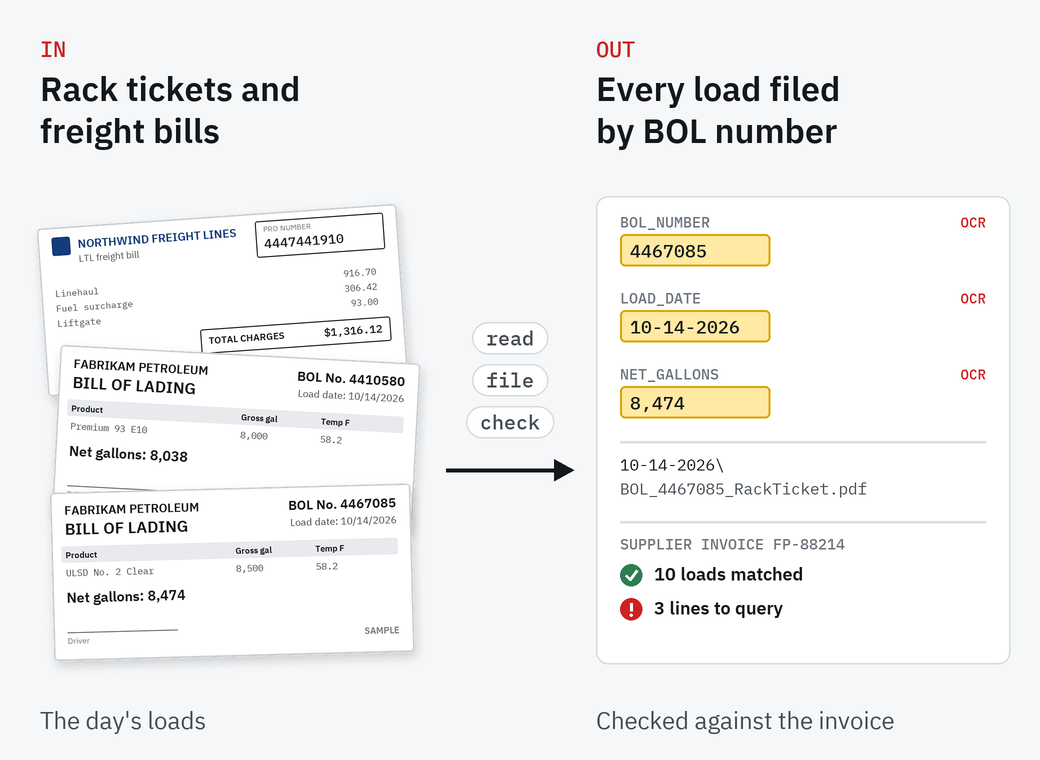
ConfigurationRack tickets and terminal bills of lading, with the driver's delivery ticket for the same load. SimpleIndex reads the BOL number, load date, product and net gallons, and files both papers side by side under the BOL number.
SimpleIndex scans, reads and files rack tickets, bills of lading, delivery tickets, fuel invoices and freight bills by BOL or PRO number, on your own servers, with one license per workstation and no fee per page.
Dispatch, fuel accounting and freight audit systems hold the numbers. The proof is still paper: the terminal's bill of lading, the driver's delivery ticket, the signed proof of delivery, the carrier's freight bill. Someone in the back office scans it, names it and files it every day, and goes looking for it when an invoice, a claim or a tax auditor asks.
SimpleIndex does that part. It doesn't replace the systems you run; it reads what is printed on each page, files it under the number your team already searches by, and keeps it on your own servers.
One kind of document at a time, with the same software and its own job settings for each.
Rack tickets and terminal bills of lading, with the driver's delivery ticket for the same load. SimpleIndex reads the BOL number, load date, product and net gallons, and files both papers side by side under the BOL number.
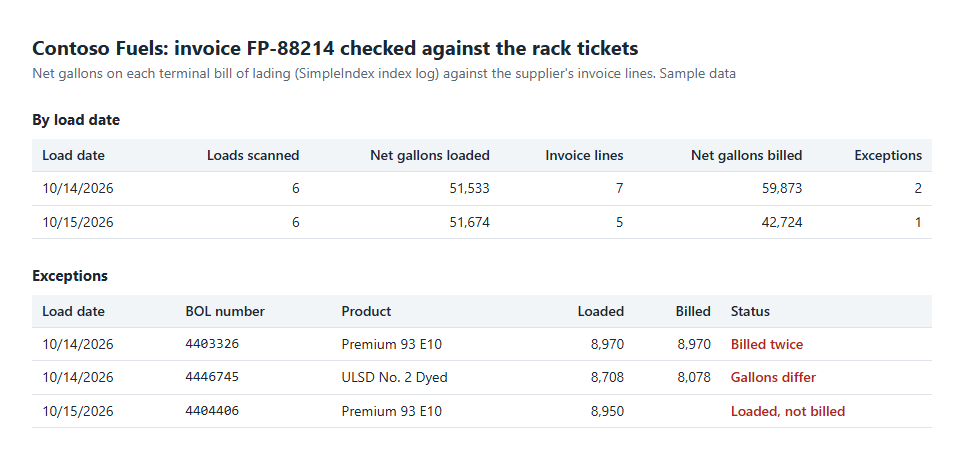
A supplier invoice lists the BOL numbers it bills. With every load on file under the same number, the net gallons on each invoice line can be checked against what left the terminal.
Terminal shipping papers name the destination state, and exemption certificates name the customer. Both are filed by state and month or by customer, ready when a state fuel tax or IFTA auditor asks.
Carrier freight bills in every layout, behind a batch header sheet for each client. SimpleIndex reads the carrier, PRO number, BOL number and total, files one PDF per bill and writes a CSV your audit system can load.
BOLs and signed PODs filed under the shipment, with a check that the signature box on each POD isn't empty. It checks that a signature is there, not whose it is.
Every carrier lays its bill of lading out differently. A language model reads the shipper, consignee, BOL number and pieces by their labels, and handwritten exception notes such as "2 cartons damaged" can be read too, depending on how neatly they're written.
Freight bills and delivery receipts go through the same steps with their own settings, set up once in the SimpleIndex Configuration Wizard.
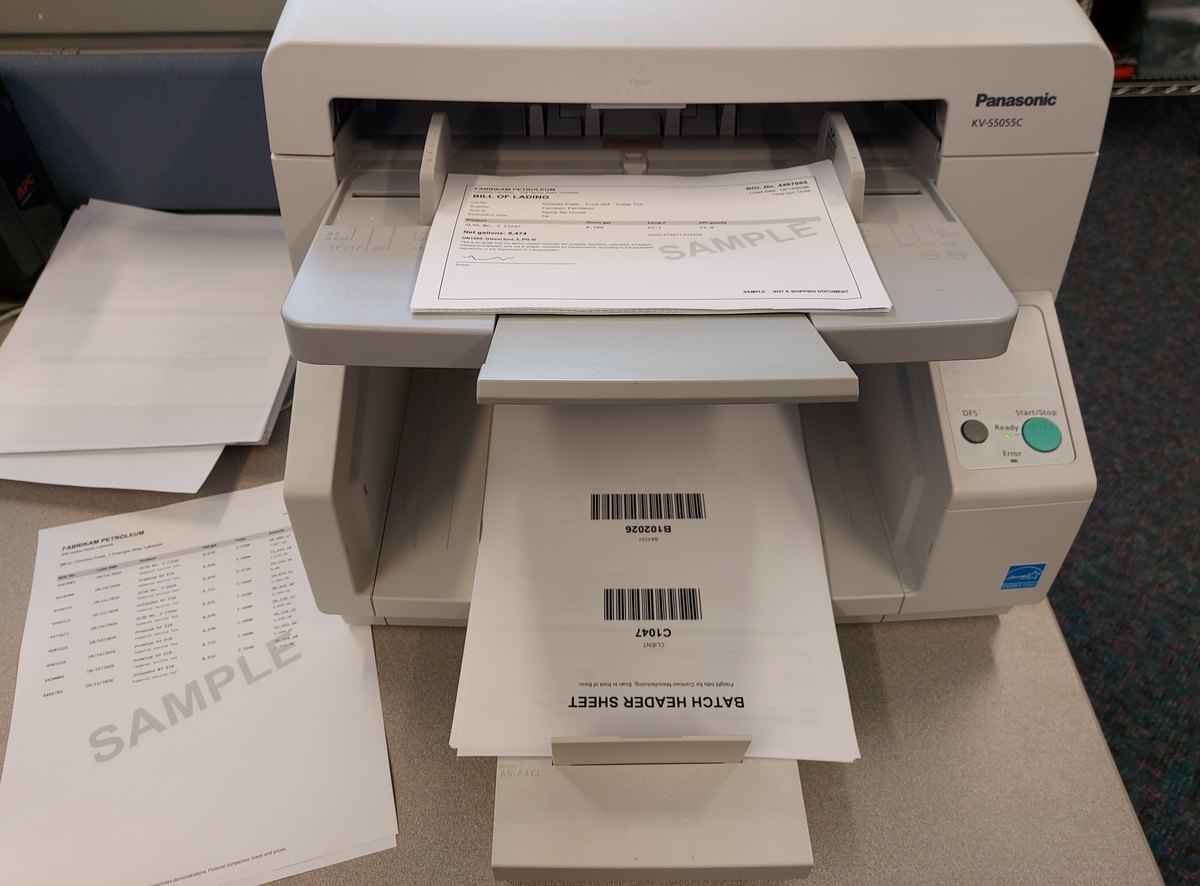
The dispatcher scans the day's rack tickets and delivery tickets as one stack, or saves the scans to a shared folder.
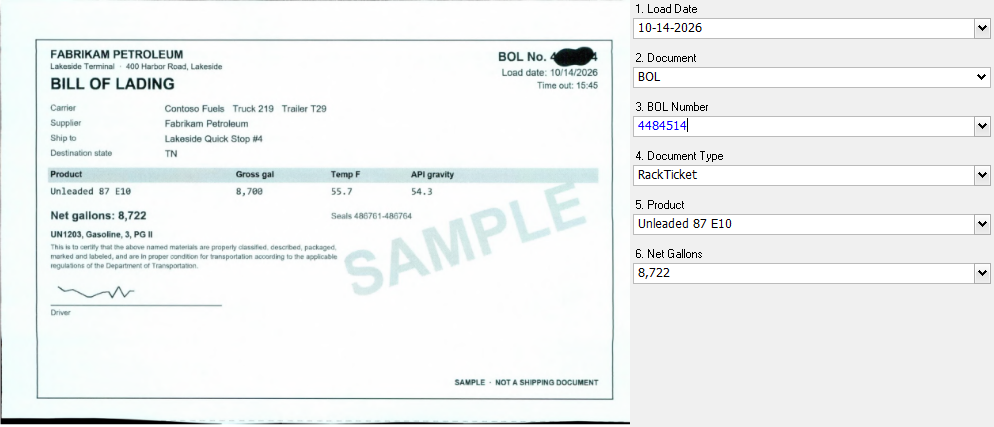
SimpleIndex reads the BOL number, load date, product and net gallons. A ticket it can't read, such as one with a smeared number, stops on screen for the clerk to type it.
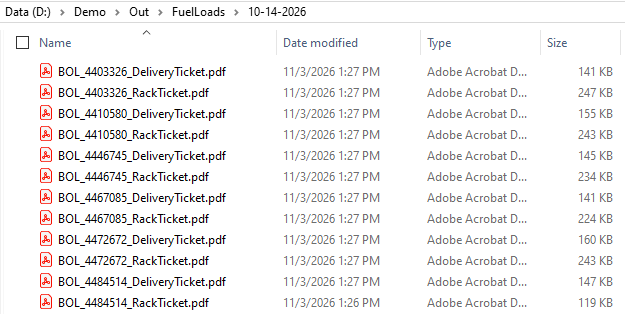
Each ticket is saved as a searchable PDF named by its BOL number, in a folder for its load date, so the rack ticket and the delivery ticket sit side by side. The index log lists every load.
The log is matched with the supplier's invoice lines: gallons loaded against gallons billed. A load billed twice, or not at all, stands out.
A freight audit team scans each client's bills behind a batch header sheet. SimpleIndex splits the stack at each sheet, leaves the sheet out, reads three carriers' layouts and files every bill by client and batch, with a CSV of PRO numbers, BOL numbers and totals.
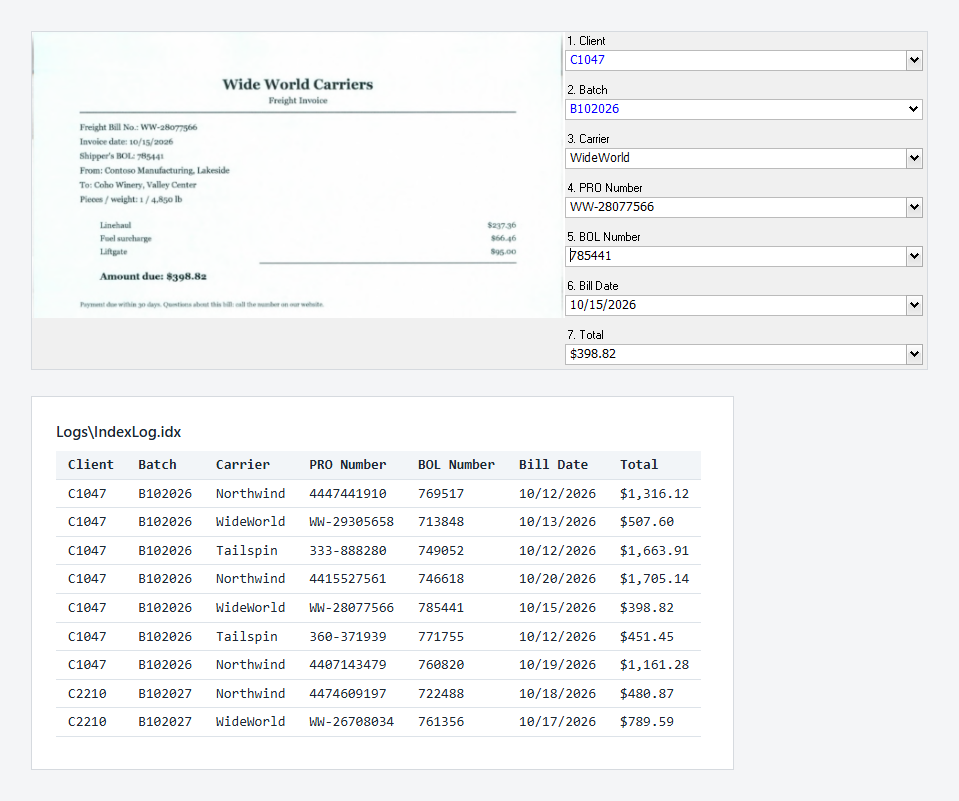
Sample documents made for SimpleIndex demonstrations. Contoso, Fabrikam, Northwind, Wide World and Tailspin are made up.
Rules differ by state and by contract, and your compliance team decides what to keep and for how long. This is where SimpleIndex sits against the ones that come up most.
Fuel invoices, bills of lading, delivery tickets, tax forms and carrier freight bills have been the largest part of our capture consulting since 2021, for fuel suppliers and distributors, a refiner and freight audit firms. The same team sets up SimpleIndex jobs and trains your staff.
SimpleIndex is installed on your own workstations and servers. Scans aren't sent to an outside service unless you choose a cloud OCR engine for a job.
SimpleIndex Professional is $1,800 per workstation, including the first year of support, then $300 a year. You buy each license once, with no charge per page. The server processing add-on, which runs large batches unattended, is sold separately for $600.
Ten sample pages: rack tickets, delivery tickets, a supplier invoice or a stack of freight bills, with anything confidential blacked out.
We build a job for them and show you the result on a 20-minute call, on your own documents.
We ask what you are processing because the answer changes what we would show you.
Yes. A language model reads fields by their labels, whatever the layout, so one job handles bills of lading from many carriers. Your own forms, which never change, are read by zones or by their barcodes at no cost per page.
Yes. It counts the dark pixels in the signature box and flags the receipts where it's empty. It checks that a signature is there, not whose it is. See optical mark recognition.
Yes. Proofs of delivery that arrive by email are converted to PDF and read like any scan, and remote sites scan into folders a central SimpleIndex server picks up. Unattended central processing needs a SimpleIndex Server license.
Neat hand print, yes, and how well depends on the writing and the engine. Cloud engines and language models read free handwriting best, but no method reads flowing cursive reliably. See handwriting recognition.
No. It files the paper those systems leave behind, where they pick it up: a watched folder, a database through ODBC, or an import module such as OnBase or Laserfiche. It doesn't need an API.
Professional covers everything on this page, including the AI engines, handwriting, mark recognition and email input. Barcodes and searchable PDFs also work in Standard. A central server that processes remote scans unattended adds a Server license.
The free trial runs the full software on your own files, and our team in Knoxville can help you set up the first job.