
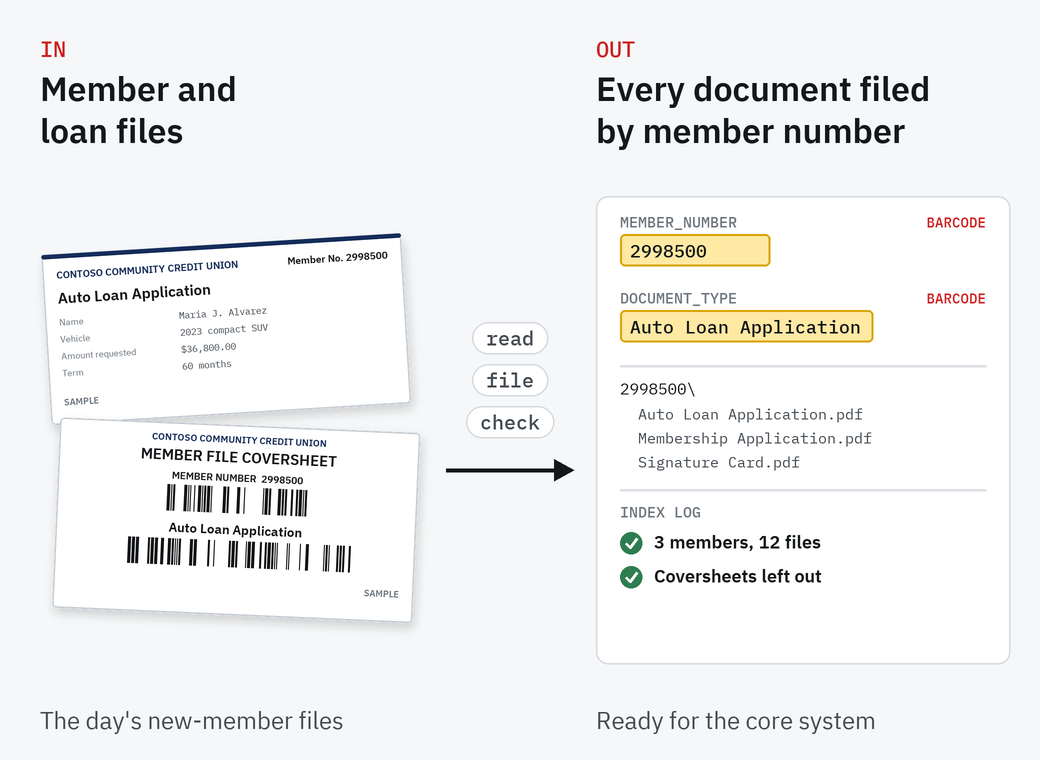
Member files
ConfigurationMembership applications, signature cards, ID copies and change forms. A barcode coversheet in front of each document, or the member number read off the form, files every page in a folder for that member.
SimpleIndex scans membership applications, signature cards, loan files, collection letters and client tax documents, and files each one under the member, account or client number your staff already search by. It runs on your own computers, with one license per workstation and no fee per page.
Your core system, collection software or tax package holds the numbers. The paper still arrives at the counter: a signed membership application, a loan file, a dispute letter, a shoebox of W-2s. Someone scans it, names it and files it every day, and goes looking for it when a member calls, an examiner visits or a client asks.
SimpleIndex does that part. It doesn't replace the systems you run; it reads what is printed on each page, or the barcode on a coversheet, files it under the right number and keeps it on your own computers.
One kind of document at a time, with the same software and its own job settings for each. Paying bills rather than filing member records? See AP automation and SimpleWorkflow for QuickBooks.
Membership applications, signature cards, ID copies and change forms. A barcode coversheet in front of each document, or the member number read off the form, files every page in a folder for that member.
Split a delivered loan package into its documents, name each one to your stacking order, and flag what's missing before the file goes to the investor or the vault.
Define what a complete new-account file holds, such as ID, signature card and application. A file that is missing a piece is flagged at the branch, not at exam time.
Placement files, payment letters, disputes and returned mail filed by account number, so a collector finds the letter while the debtor is on the phone. Letters that arrive by email are read the same way.
W-2s, 1099s, bank and brokerage statements and receipts, sorted into a folder per client and tax year as they are scanned.
A language model reads fields by their labels on statements and applications from any institution, and a table field returns each transaction as a row. Run it on a model on your own server to keep client data in-house.
Loan files, collection letters and client documents go through the same steps with their own settings, set up once in the SimpleIndex Configuration Wizard.
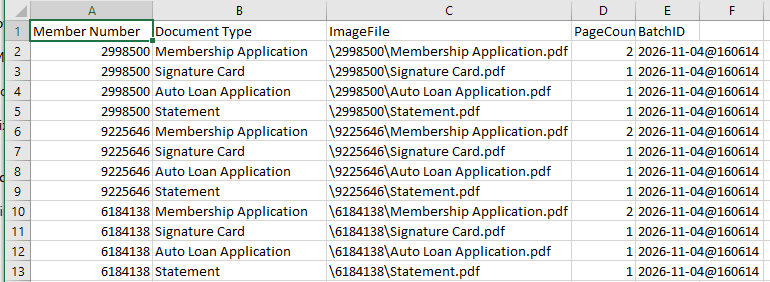
Member services puts a coversheet in front of each document and scans the day's new-member files as one stack: here three members, four documents each, 27 pages.
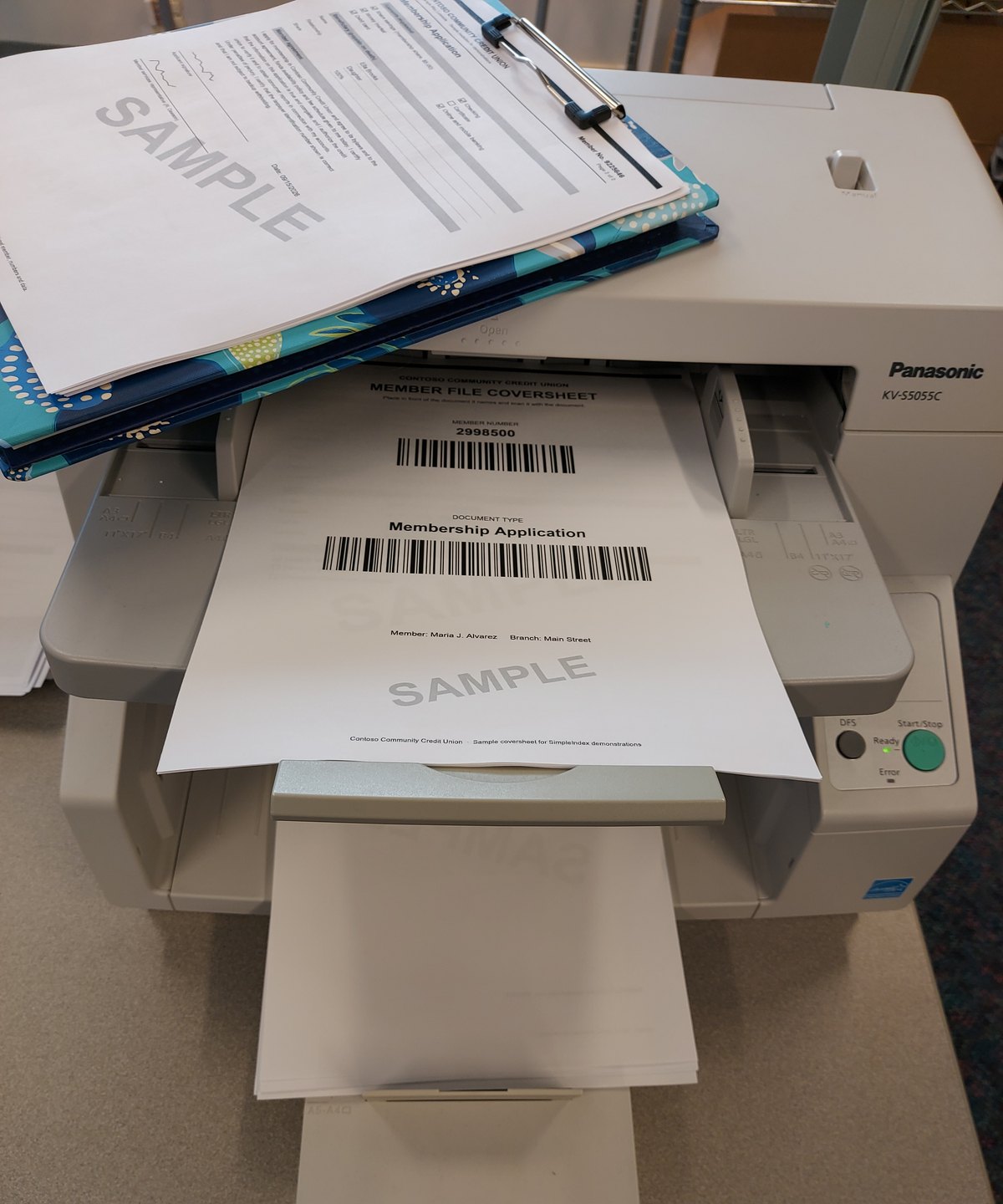
SimpleIndex reads the two barcodes on each coversheet, the member number and the document type, and gives those values to every page behind it. The coversheet itself is left out of the file.
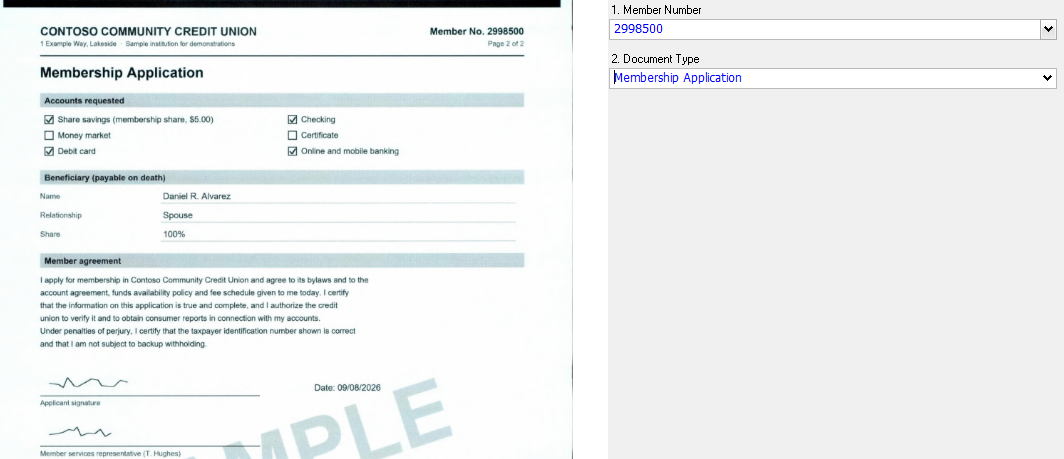
Each document is saved as a searchable PDF named by its type, in a folder for the member: 2998500\Auto Loan Application.pdf. A two-page application stays one two-page file.
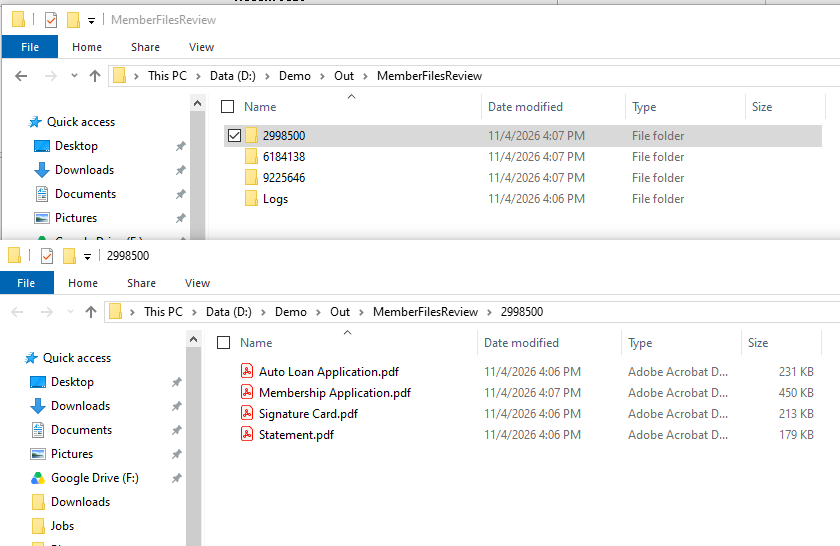
The index log lists every file with its member number, document type and page count, ready for your core or document management system to import.
A coversheet is a plain page you print yourself, with the member number and the document type as barcodes. Make a batch of them from a member list or a core report, or print one at the counter. Because the barcode carries text, the file is named "Auto Loan Application", not a code someone has to look up. If your forms already print the member or account number, SimpleIndex can read it off the page instead, and tell the documents apart by their titles.
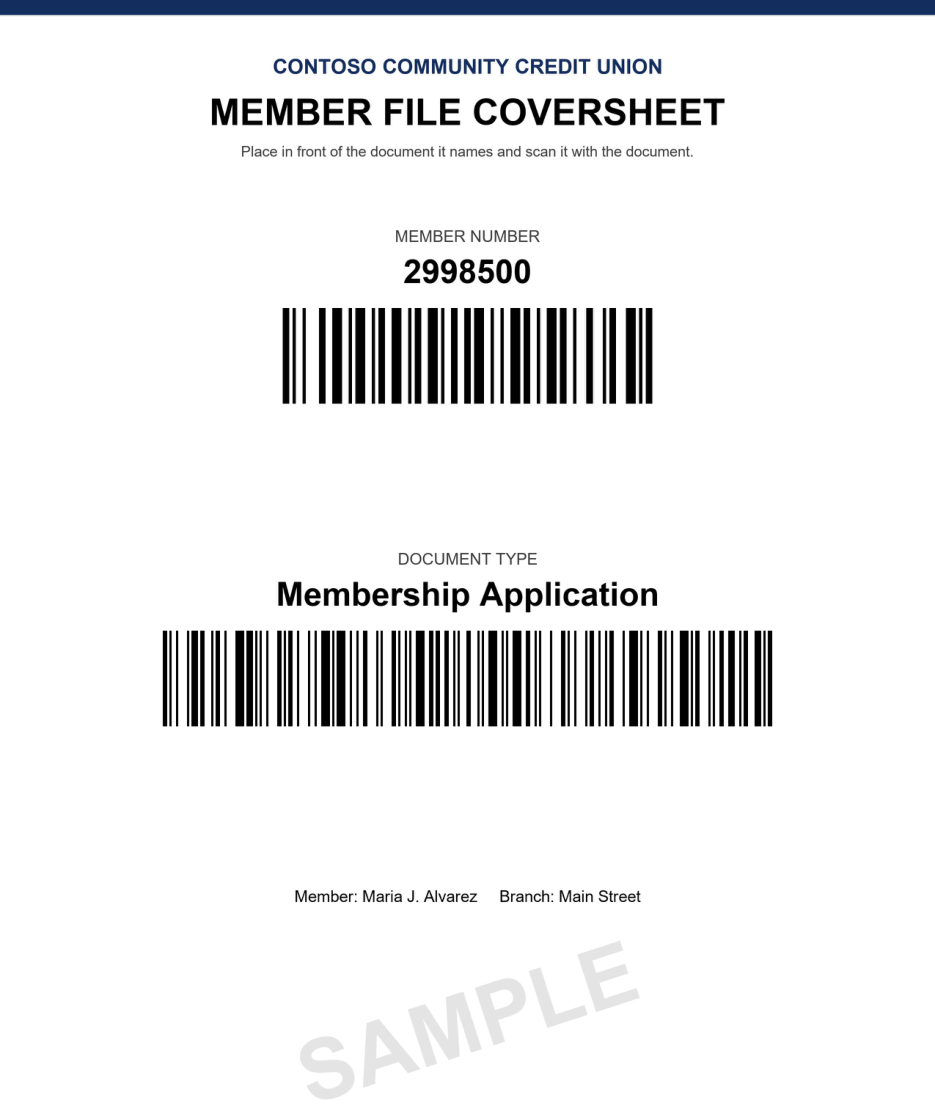
Sample documents made for SimpleIndex demonstrations. Contoso Community Credit Union, its members and their numbers are made up. See barcode indexing.
Rules differ by charter, state and contract, and your compliance team decides what to keep and for how long. This is where SimpleIndex sits against the ones that come up most.
SimpleIndex is installed on your own workstations and servers. Member and client documents aren't sent to an outside service unless you choose a cloud OCR engine for a job. In Professional, account and Social Security numbers can be blacked out in the copies you export.
SimpleIndex Professional is $1,800 per workstation, including the first year of support, then $300 a year. You buy each license once, with no charge per page. The server processing add-on, which runs branch scans unattended, is sold separately for $600.
Ten sample pages: a new-member file, a loan file, a few collection letters or one client's tax documents, with account numbers and anything else confidential blacked out.
We build a job for them and show you the result on a 20-minute call, on your own documents.
We ask what you are processing because the answer changes what we would show you.
No, unless you choose a cloud engine. SimpleOCR, Tesseract and ABBYY FineReader run on your own computer, and AI can run on a model on your own server. Textract and cloud models such as ChatGPT are optional; if you use one, check your agreement with the provider first.
No. If your forms print the member or account number, SimpleIndex reads it off the page and tells documents apart by their titles. Coversheets suit mixed paper, such as the ID copies and pay stubs members bring in.
SimpleIndex files documents into folders or a database and writes an index log your system can import. It has export presets for OnBase, Laserfiche and DocuWare, so one choice sets up everything the receiving system expects. It doesn't need an API.
Yes. LoanStacker splits a delivered package into its documents, names each one to your order and lists what is missing.
Yes. A language model reads fields by their labels, whatever the layout, and a table field returns each transaction as a row, written out as CSV beside the other values. For forms that never change, zone OCR reads them at no cost per page.
Yes, in Professional. Give an index field a pattern, turn on Redact Matches, and each matching value is blacked out in the exported PDF. Check redacted files before you share them.
Yes. Branches scan into folders that a central SimpleIndex server picks up, and every batch runs under the same job rules. Unattended central processing needs a SimpleIndex Server license. See remote capture.
Professional covers everything on this page, including the AI engines and redaction. Coversheets and searchable PDFs also work in Standard. A central server that processes branch scans unattended adds a Server license.
The free trial runs the full software on your own files, and our team in Knoxville can help you set up the first job.