FORGOT YOUR DETAILS?

CREATE ACCOUNT

Food and agriculture records, from farm to fork

For co-ops and grain elevators, growers and packing houses, processors, food and beverage distributors and food service. SimpleIndex reads the barcode and the printed values on each page, files it as a searchable PDF by ticket, invoice, grower or lot code, and writes a spreadsheet of what it read. It runs on your own computers, for one price per workstation, with no subscription and no fee per page unless you choose a cloud engine.

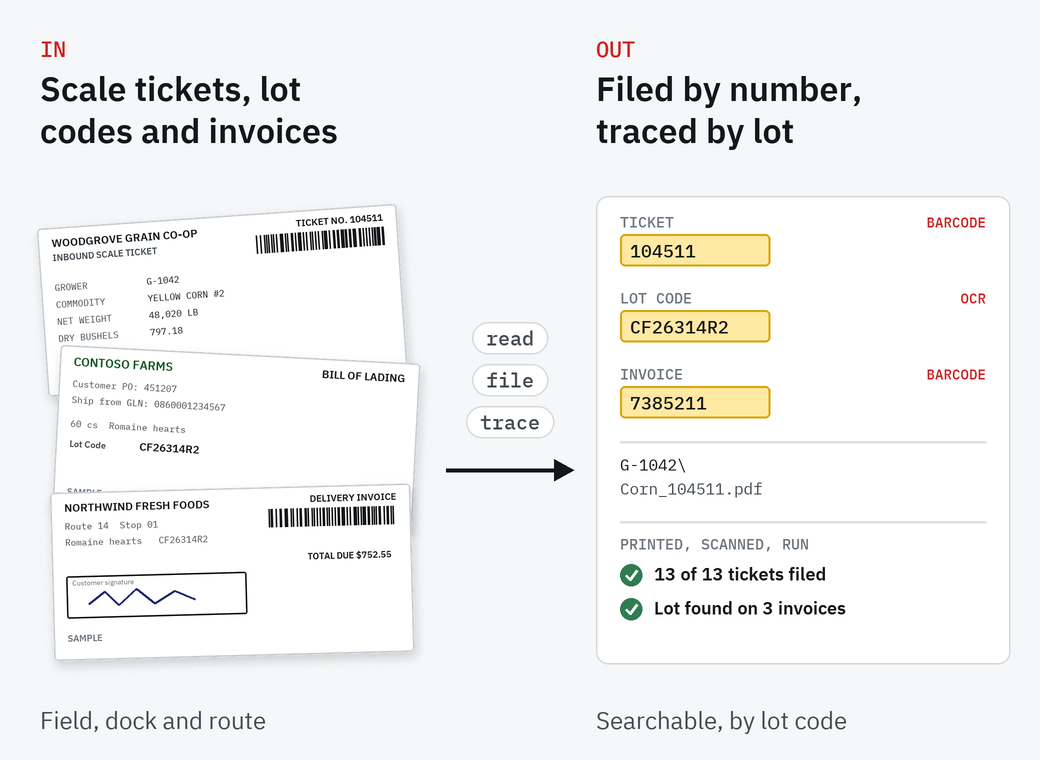
A sample Woodgrove Grain Co-op scale ticket, a Contoso Farms bill of lading with lot code CF26314R2 and a signed Northwind Fresh Foods delivery invoice go through read, file and trace: ticket 104511 and invoice 7385211 read from barcodes, the lot code by OCR, filed as G-1042\Corn_104511.pdf; 13 of 13 tickets filed and the lot found on 3 invoices

Your scale software, ERP, route accounting and food safety systems hold the numbers. The proof is still paper: the scale ticket the driver took home, the invoice the restaurant signed, the packing slip with the lot code, the HACCP log from the night shift.

SimpleIndex turns that paper into named, searchable files and an index your systems can import, so a settlement question, a disputed delivery or a recall is a search, not a trip to the file room. It does not replace the systems you already run.

What it takes

Cost. One license per workstation, the first year of support included, then a yearly renewal. No subscription, and no fee per page with the local OCR engines; a cloud engine such as AWS Textract or a cloud AI model is billed per page by its provider.

Effort. One Windows PC and the scanner you already have. The scale house, the dock or the route office scans the day's stack; SimpleIndex reads it, and anything it is not sure of stops on screen for a check. We build your first job from ten of your own pages.

Fit with your rules. Files stay on your own computers. One searchable PDF per ticket, invoice or delivery, filed by the number you look things up by, so each retention rule is easy to apply. The index log is a spreadsheet you can sort by lot code when FDA asks.

Records, from field to kitchen

Every link in the chain files by its own number. The software is the same; the job is set to the number and the documents you handle.

Configuration

Scale tickets, FSA-578 acreage reports, crop insurance production records, pesticide and organic records, H-2A payroll, health certificates and Veterinary Feed Directives, filed by field, herd, crop year and document type. Crop insurers ask for each scale ticket, not a summary, so each ticket gets its own file.

Uses barcode coversheets · full-page OCR

Inbound scale tickets filed by grower and crop year, one PDF per ticket, read for ticket number, commodity, net weight, moisture and dry bushels. The index log is checked against the scale register: a missing ticket or a typing slip shows up before settlement.

Uses barcodes · full-page OCR

Harvest and lot records, agricultural water tests, GAP and GHP audit paperwork, and PACA invoices and passing documents, filed by lot and buyer.

Uses full-page OCR · searchable PDF

HACCP monitoring and corrective-action logs, sanitation records, pasteurization charts, milk weight tickets and suppliers' letters of guarantee, filed by line, product and production date, kept as long as each rule asks.

Uses barcode coversheets · searchable PDF

Signed delivery invoices filed by invoice number and route, credit memos beside the invoice they credit, and a check that each invoice came back signed. Beverage, wine and spirits distributors use SimpleIndex to file barcoded route invoices unattended on a server.

Uses barcodes · signature check · server

Vendor invoices, receiving and temperature logs, and school meal production records and claims, filed by vendor, date and site.

Uses full-page OCR · searchable PDF

From the scale house to the kitchen

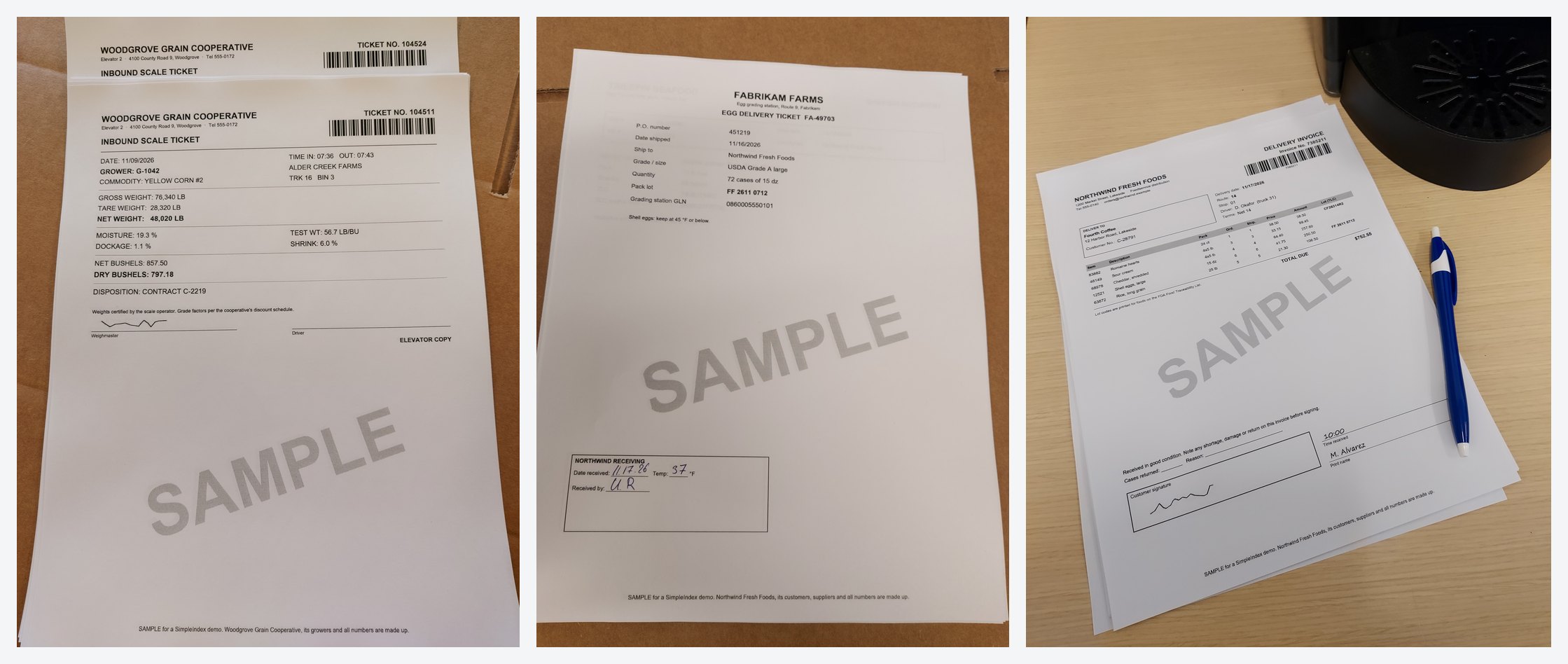
The sample paperwork behind this page, printed, filled in and scanned in our office: a grain elevator's scale tickets, a supplier's egg delivery ticket stamped at the receiving dock, and a signed delivery invoice where it ends up, by a restaurant's coffee machine.

Three photos: sample Woodgrove Grain Cooperative scale tickets on a carton, a Fabrikam Farms egg delivery ticket with the receiving box filled in by hand, and a signed Northwind Fresh Foods delivery invoice beside a coffee machine and a pen

Sample paperwork made for SimpleIndex demonstrations. Every company, name and number is made up.

Example route_14

One route's paperwork, start to finish

We printed a sample distributor's route, 11 delivery invoices and a credit memo, signed them like customers would, scanned the stack and ran it through SimpleIndex 12. All 12 pages filed under the right invoice number, and every signature check was right.

  1. Scan the driver's stack

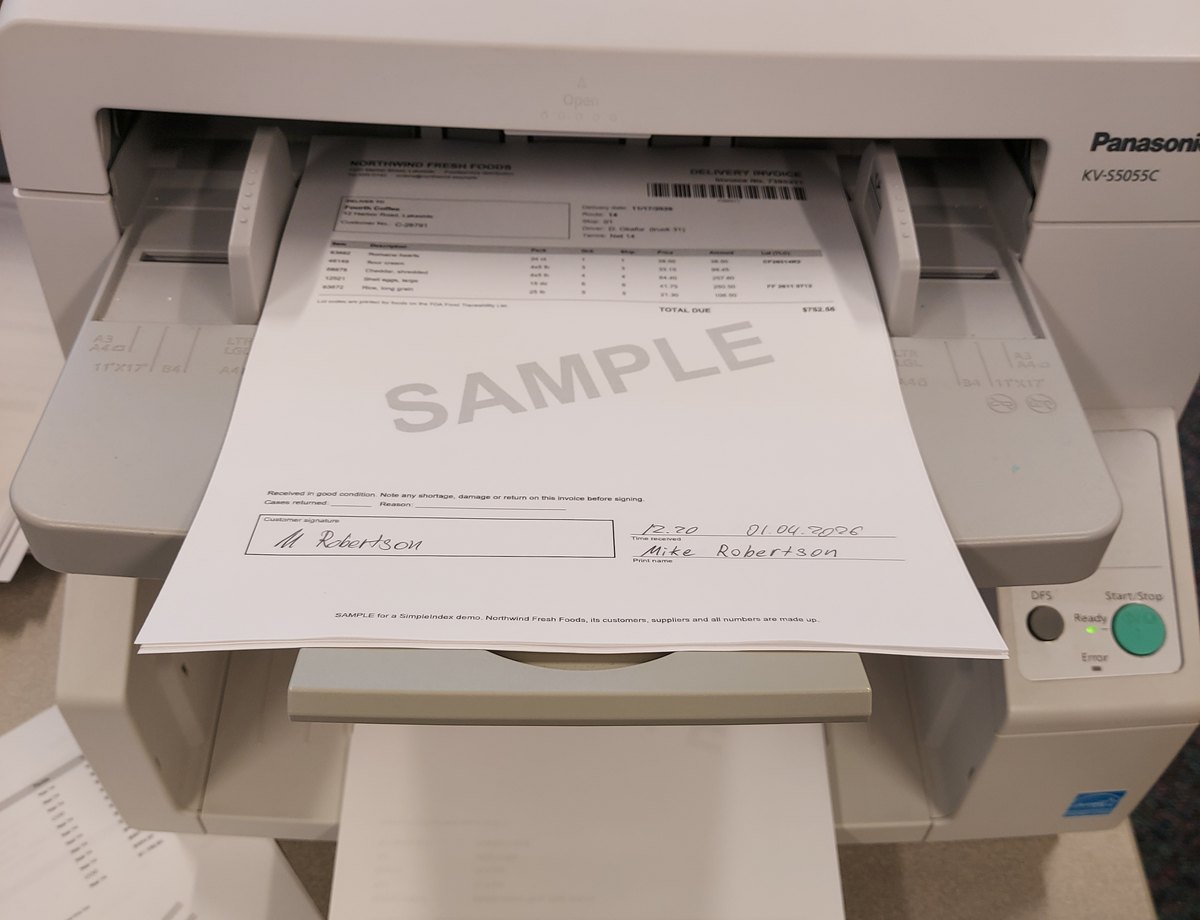
    The signed invoices come back off the truck in route order. They go through the scanner as one stack, credit memos and all.

    A signed sample Northwind Fresh Foods delivery invoice for Fourth Coffee on top of the route stack in a document scanner feeder
  2. Read the barcode and the page

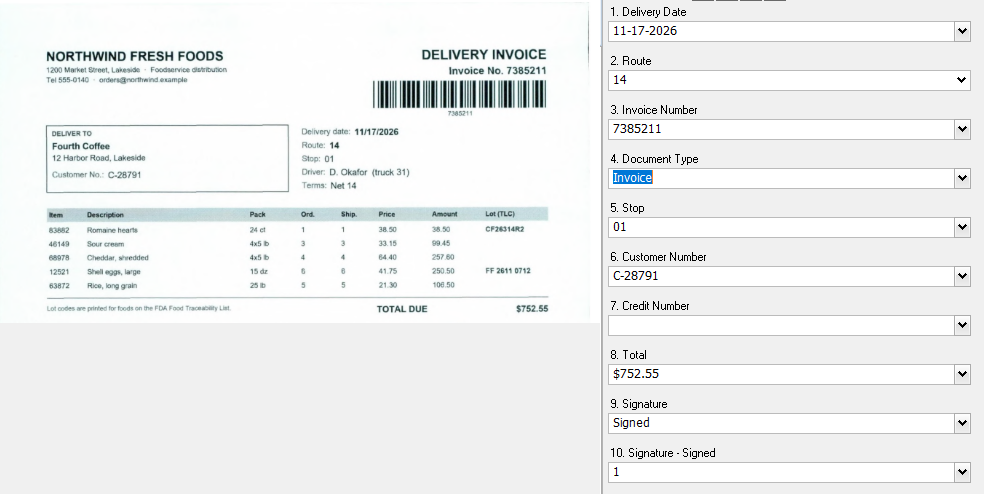
    SimpleIndex takes the invoice number from the barcode your route system prints, and the delivery date, route, stop, customer number and total from the page. One barcode had a smear across it; that invoice stopped on screen and the number was typed from the page.

    The sample invoice for stop 01 in SimpleIndex beside its index fields: delivery date 11-17-2026, route 14, invoice number 7385211, document type Invoice, stop 01, customer C-28791, total $752.55, signature Signed
  3. Check the signature, file the invoice

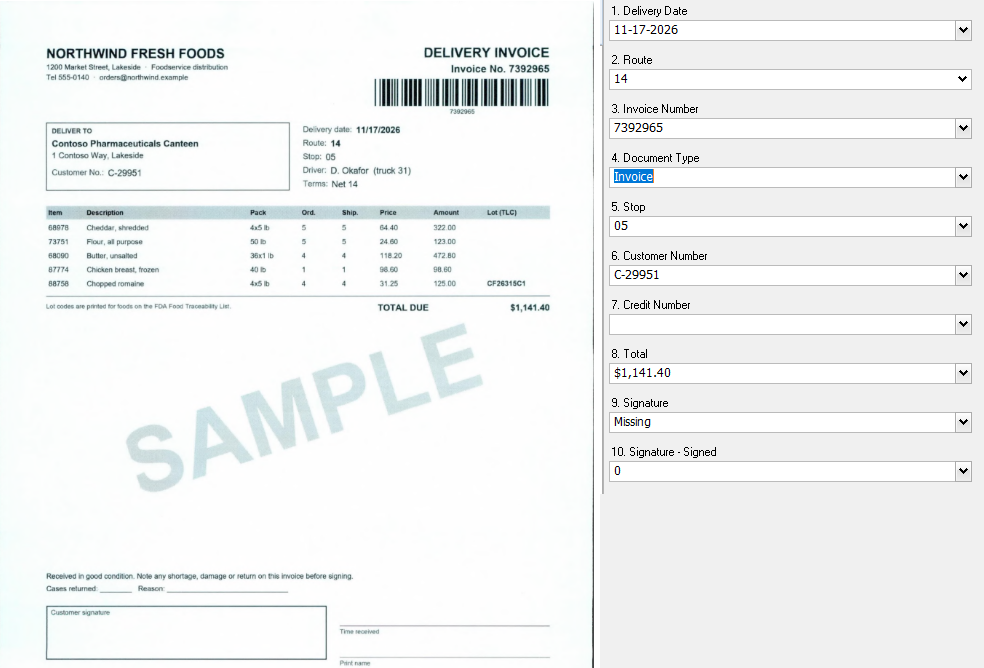
    A pixel count in the signature box tells a signed invoice from an unsigned one: in our run, stop 5 came back unsigned and was marked Missing. Each invoice is filed as a searchable PDF by delivery date and route.

    The sample invoice for stop 05 with an empty customer signature box, beside its index fields with Signature Missing
  4. Settle the route

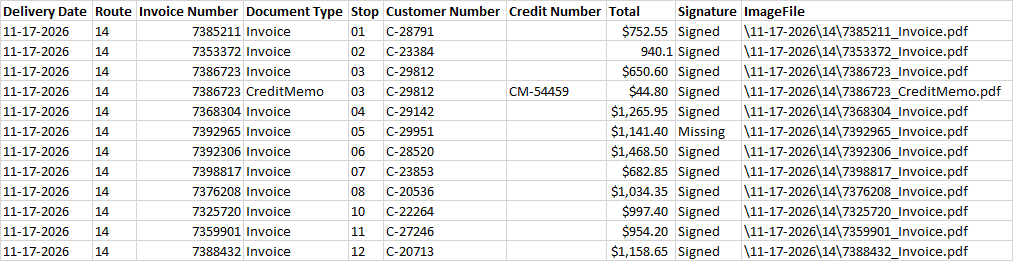
    The index log opens in Excel next to the route manifest from your route accounting system. In our run it showed what a settlement clerk needs: 11 of 12 invoices back, one unsigned, one credit of $44.80 against stop 3.

    The route index log in Excel: twelve rows with delivery date, route 14, invoice number, document type, stop, customer number, credit number CM-54459 on the credit memo, total, signature Signed or Missing, and the file path

Credit memos beside their invoice

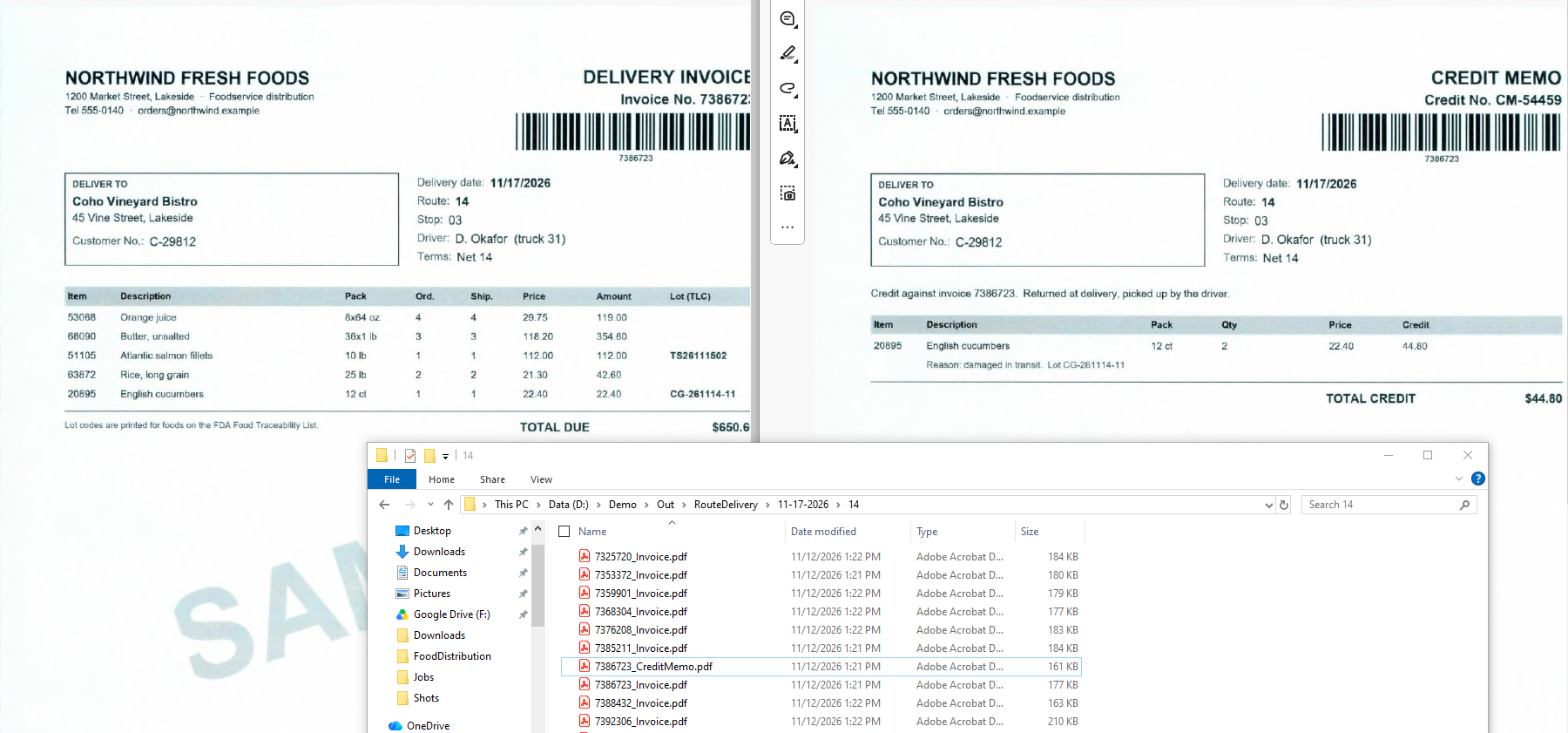
The credit memo for two damaged cases carries the same invoice number as a barcode, so it is filed next to the invoice it credits: 7386723_Invoice.pdf and 7386723_CreditMemo.pdf in the folder for 11-17-2026, route 14.

The sample delivery invoice 7386723 and its credit memo CM-54459 for $44.80 open side by side, over Windows Explorer showing the route 14 folder with 7386723_CreditMemo.pdf beside 7386723_Invoice.pdf

Sample paperwork made for SimpleIndex demonstrations. Northwind Fresh Foods, its customers, suppliers and every number are made up.

One lot, from the dock to every customer

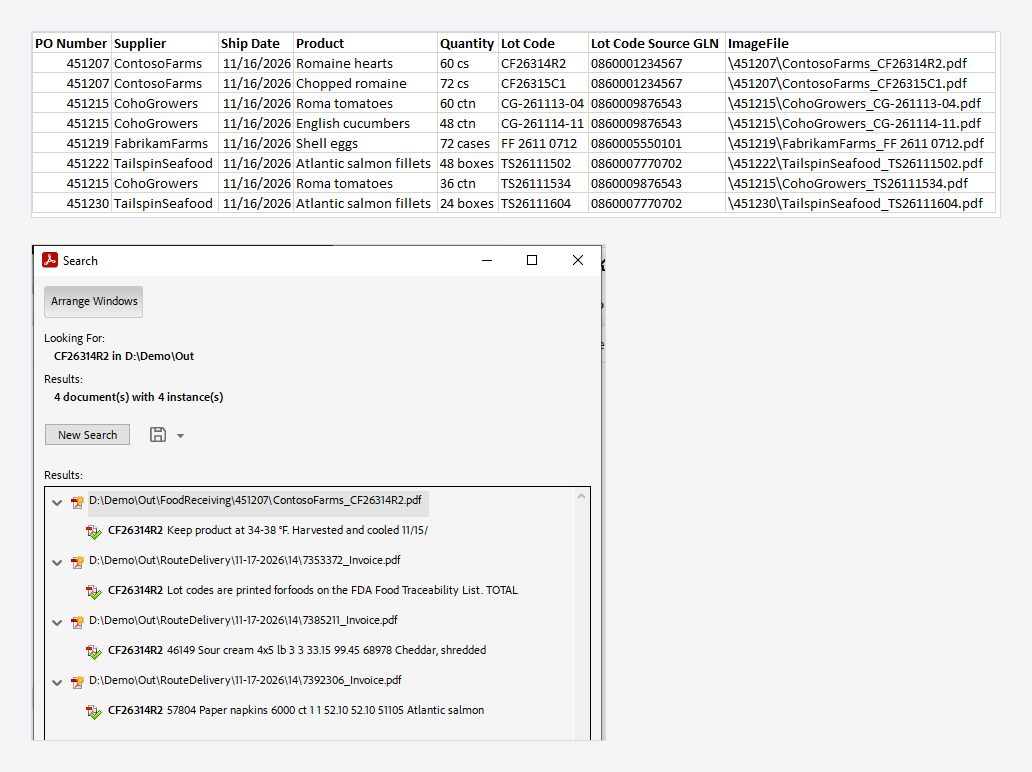
Foods on FDA's Food Traceability List, such as leafy greens, tomatoes, cucumbers, shell eggs and fresh fish, arrive with a traceability lot code on the supplier's paper. In our sample, four suppliers printed it four ways. SimpleIndex read the PO number, supplier, ship date, product, quantity and lot code source on all 8 papers and the lot code on 7; the eighth had a smudge across it and stopped on screen. Each paper is filed by PO and lot code, and the index log is a spreadsheet of lot codes you can sort and send. Because the delivery invoices print the lot codes too, a search in Adobe Acrobat for lot CF26314R2 found the supplier's bill of lading and the three customers' invoices that carried it.

Above, the receiving index log in Excel: eight rows with PO number, supplier, ship date, product, quantity, lot code and lot code source GLN. Below, Adobe Acrobat search results for CF26314R2 in the output folder: the Contoso Farms bill of lading and invoices 7353372, 7385211 and 7392306

The rule asks you to keep these records for two years and hand them to FDA within 24 hours, as a sortable spreadsheet during an outbreak. Scanned copies count.

Two days of scale tickets, one file per load

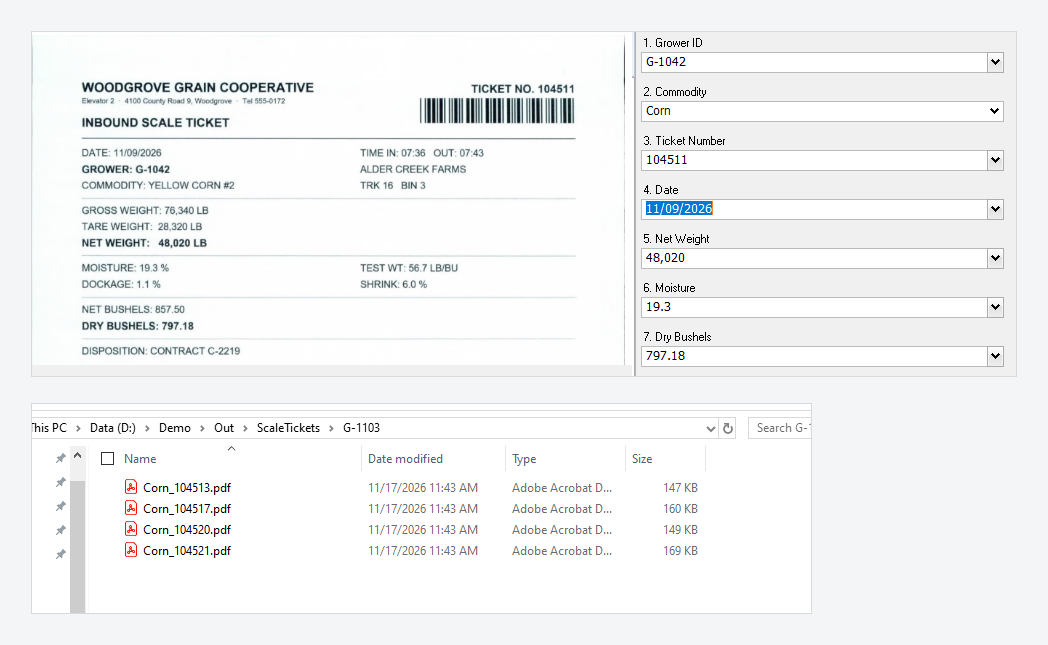
A sample country elevator's inbound scale tickets, 13 loads of corn and soybeans from three growers, printed, scanned and run through SimpleIndex 12. It read the ticket number from the barcode and the grower, commodity, date, net weight, moisture, dry bushels and disposition from the page, and filed each ticket as its own PDF in the grower's folder. Every value it read was right on all 13 tickets.

Sample scale ticket 104511 in SimpleIndex beside its index fields: grower G-1042, commodity Corn, ticket 104511, date 11/09/2026, net weight 48,020, moisture 19.3, dry bushels 797.18; below, Windows Explorer with four corn tickets in the folder for grower G-1103

Checked against the scale register

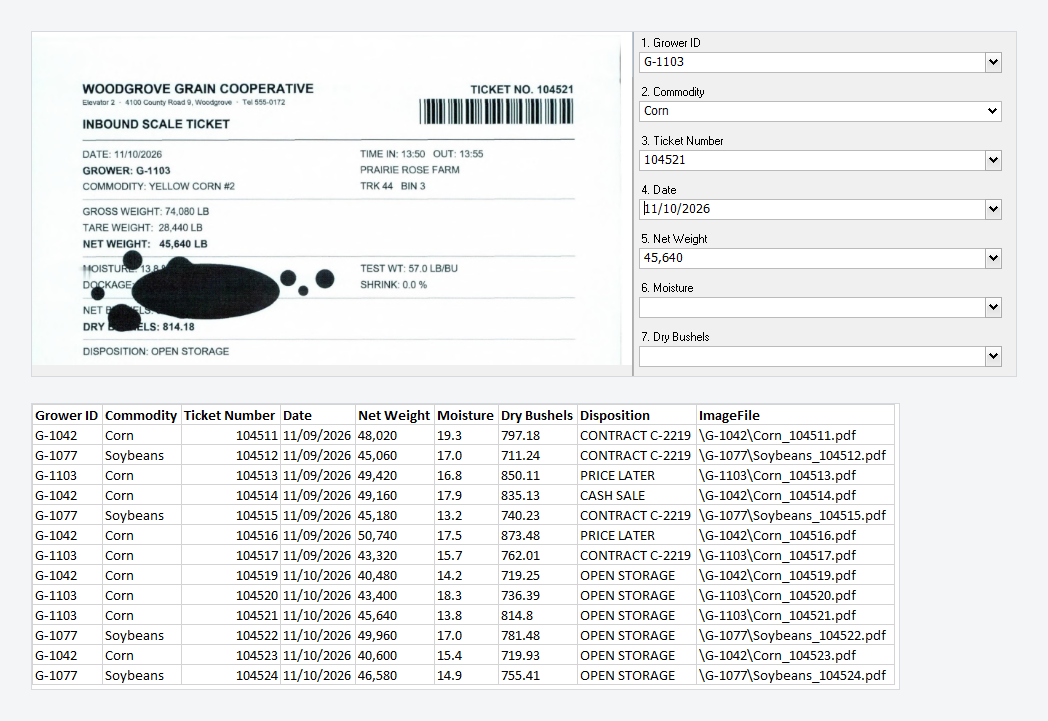
One ticket had a spill across its moisture and bushel lines, so it stopped on screen for typing. The index log, checked against the scale register, then showed two things a settlement clerk wants to see first: one ticket in the register that never reached the office, and the typed bushels, 814.8 where the register says 814.18.

Sample scale ticket 104521 with a spill over its moisture and bushel lines in SimpleIndex, Moisture and Dry Bushels empty; below, the scale ticket index log in Excel, thirteen rows, with 814.8 typed for ticket 104521

Sample scale tickets made for SimpleIndex demonstrations. Woodgrove Grain Cooperative, its growers and every number are made up.

How long records are kept: farms and growers

Federal rules set how long food and farm records are kept, and some accept scanned copies. SimpleIndex does not make a business compliant on its own; it files records so each rule is easy to follow.

Restricted-use pesticide records
2 years from the application. 7 CFR 110.3
Crop insurance production records
3 years after the end of the crop year, scale tickets included. 7 CFR 457.8, section 21
Organic records
5 years. 7 CFR 205.103
H-2A earnings records
3 years after the certification. 20 CFR 655.122(j)
Produce Safety Rule records
Veterinary Feed Directives
2 years, for the veterinarian, the distributor and the client. 21 CFR 558.6

How long records are kept: packers, processors and dealers

Egg safety records
1 year after the flock leaves production. 21 CFR 118.10
Dairy temperature and pasteurization records
Bulk-tank temperature records 6 months, plant pasteurization charts 2 years, under the Grade "A" Pasteurized Milk Ordinance as adopted by each state.
Feed mill preventive controls
Food plant preventive controls
Meat, poultry and seafood HACCP
1 year for refrigerated product, 2 years for frozen, preserved or shelf-stable. 9 CFR 417.5, 21 CFR 123.9
Produce dealers (PACA)
2 years after the transaction closes. 7 CFR 46.14

How long records are kept: distribution and food service

FDA will not enforce the food traceability rule before 20 July 2028. Restaurant records under the Food Code are set by states and counties.

Food Traceability List foods
Lot code records 2 years, to FDA within 24 hours; scanned copies count. 21 CFR 1.1455
One step back, one step forward
6 months to 2 years, by shelf life, for every food business. 21 CFR 1.360
Meat wholesalers and warehouses
2 years after 31 December of the year. 9 CFR 320.3
Sanitary transportation
Procedures and agreements 12 months after they stop being used. 21 CFR 1.912
Beer, wine and spirits wholesalers
At least 3 years. 27 CFR 31.191
School meals
3 years after the final claim for the year. 7 CFR 210.23

Who uses it

Farms and farm co-ops, produce grower-shippers, food distributors, beverage, wine and spirits distributors and food makers use SimpleIndex, in the US and abroad. Beverage distributors run it on servers to file barcoded route invoices as the trucks come in.

On your computers, for one price

SimpleIndex Professional is $1,800 per workstation, including the first year of support, then $300 a year. It reads barcodes and printed values, checks signature boxes and runs every example on this page. No subscription. The local engines have no charge per page; a cloud engine such as AWS Textract or a cloud AI model is billed per page by its provider. Purchase orders accepted.

We build your first job

Send us ten pages of what you want to scan, scale tickets, invoices, packing slips or logs, with anything confidential blacked out, and tell us how you file them today.

We build a SimpleIndex job that reads them and show it to you on a 20-minute call.

We ask what you are processing because the answer changes what we would show you.

How it goes
You tell us what you scan
Document types, volume, the number you file by
You send samples
Ten pages, anything confidential blacked out
We build a working job
On your documents, before the call
We show you the result
A 20-minute call with the files named and filed
What it costs
Nothing unless you buy. If you do, the setup is billed at the consulting rate

Questions from food and farm businesses

What does it cost, and are there page fees?

One license per workstation: Professional is $1,800 including the first year of support, then $300 a year. No subscription, and no charge per page with the local engines; a cloud engine is billed per page by its provider, only if you choose one.

Our route or scale software prints its own documents. Can SimpleIndex read them?

Yes, if the number you file by is printed on the page or as a barcode. Send us ten pages and we will show you the job working on them.

Can it tell a signed invoice from an unsigned one?

Yes, in Professional. It counts the dark pixels in the signature box and flags the invoices where it is empty. It checks that a signature is there, not whose it is.

Does a scanned copy count for the food traceability rule?

Yes. 21 CFR 1.1455 accepts true copies, scans included, kept for two years and produced within 24 hours of FDA's request. SimpleIndex files each paper as a searchable PDF and writes the lot codes to a spreadsheet you can sort.

Our scale tickets come from an old dot-matrix printer. Will it read them?

Usually, but less cleanly than laser-printed tickets, so more values stop on screen for a check. Send us a few tickets and we will tell you what to expect.

Can it run unattended for several scale houses or routes?

Yes. With the server add-on, SimpleIndex watches a folder and files each batch as it arrives, from any scanner on the network.

Can the index go into our ERP, scale or route accounting software?

SimpleIndex writes an index log, one row per document, that most systems can import. It can also save into a watched folder, a SharePoint library or a database.

Do our records leave the building?

No. Scanning, reading and filing happen on your own computers. Cloud reading engines are an option you turn on, never the default.

Try it on your own documents

The free trial runs the full software on your own files, and our team in Knoxville can help you set up the first job.

TOP